White noise, pink noise and brown noise all spread sound across a wide range of frequencies, but they distribute that energy differently. White noise is defined by equal power per frequency, pink noise gradually reduces power as frequency rises, and brown noise gives still more relative weight to low frequencies.
Which one is best for sleeping or studying?
Science does not currently give us a universal winner. White and pink noise have been studied considerably more than brown noise, and results vary by person, task, sound level and—especially for sleep—whether there is environmental noise to mask. Reviews of the sleep literature repeatedly describe the evidence as heterogeneous rather than showing one noise color to be consistently superior (Riedy et al., 2021) (Capezuti et al., 2022).
White, Pink and Brown Noise at a Glance
| Property | White noise | Pink noise | Brown noise |
|---|---|---|---|
| Idealized spectral relationship | Equal power per Hz | About −3 dB/octave | About −6 dB/octave |
| Typical perception | Bright, hiss-like | Softer, smoother | Deep, rumbling |
| Sleep research | Most extensive | Moderate | Very limited |
| Focus research | Most extensive | Some | Limited |
| Proven best for sleep? | No | No | No |
| Proven best for focus? | No | No | No |
The key distinction is simple:
Noise color describes the spectrum of a sound. It does not automatically describe what that sound will do to your brain.
What Makes Noise White, Pink or Brown?
The names describe how acoustic power is distributed across frequencies.
White noise contains approximately equal power at each individual frequency. Because each octave contains more individual frequencies as pitch rises, ideal white noise is usually perceived as relatively bright or hiss-like.
Pink noise decreases in power by roughly 3 dB for every octave. This produces relatively more low-frequency energy than white noise and is generally perceived as softer.
Brown noise, also called Brownian noise and sometimes red noise, decreases more steeply—roughly 6 dB per octave in its idealized form. This produces a deeper, bass-heavy sound.
Those are mathematical reference definitions. Real listening tracks can be filtered or mastered differently from ideal laboratory signals.
What Our Own Noise Recordings Actually Look Like
To add first-party data to this comparison, we analyzed representative three-minute MP3 recordings from The Quiet Hub's current white, pink and brown noise collections using the same method for all three.
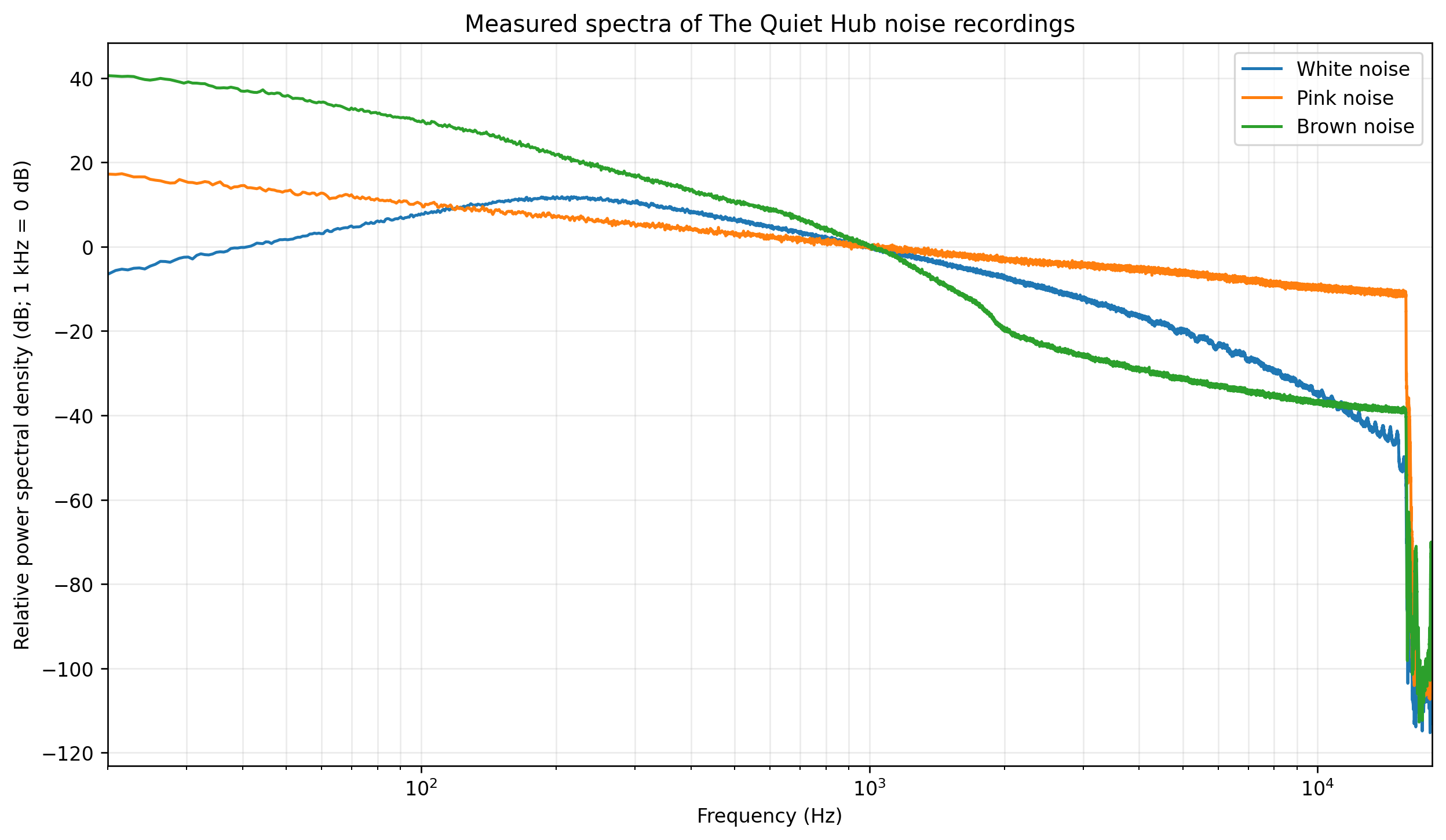
The recordings do not line up perfectly with ideal mathematical definitions—and that is useful to show.
Across the main 100 Hz–10 kHz analysis range, the measured spectral slopes were approximately:
The spectral-centroid measurements also differed strongly: approximately 512 Hz for the white recording, 2.47 kHz for pink and 69 Hz for brown. These descriptors reflect the actual encoded recordings and their filtering/mastering, not an assumption that a track label must match an ideal reference curve.
The one-second RMS analysis also found different levels of short-term amplitude variation: approximately 0.15 dB standard deviation for white, 0.28 dB for pink and 0.50 dB for brown. None of the analyzed files showed digital clipping.
What Does Research Say About Noise and Sleep?
The simplest story would be that one color produces deeper or better sleep than the others.
The evidence is not that clean.
A 2021 systematic review of noise as a sleep aid found that studies varied substantially in participants, sound types, exposure levels and outcomes, making strong general conclusions difficult (Riedy et al., 2021). A broader 2022 systematic review of auditory stimulation reached a similarly cautious conclusion: some interventions improve particular sleep outcomes, but protocols and evidence quality are heterogeneous (Capezuti et al., 2022).
One mechanism is nevertheless straightforward: masking.
If intermittent traffic, doors, voices or other environmental sounds are waking you, a continuous background can reduce the contrast between quiet and those events. In that situation, the value of the added sound may come less from a special effect of its “color” and more from making external events less acoustically prominent.
White Noise and Sleep
White noise has the largest sleep research base of the three colors. Controlled studies and reviews report positive results in some settings, including noisy clinical environments, but not every study finds the same benefit and the protocols differ widely (Ding et al., 2025).
A careful interpretation is therefore:
White noise may be useful when environmental sound is itself disturbing sleep, but it is not a universally proven sleep enhancer.
Prefer a brighter, broadband background? Listen to White Noise
Pink Noise and Sleep
Pink noise needs an important clarification because two very different ideas are often mixed together online.
Some sleep research uses closed-loop auditory stimulation: short, precisely timed sounds delivered in relation to measured slow-wave brain activity. That is not the same intervention as playing continuous pink noise from a streaming service throughout the night.
Recent controlled studies of continuous pink noise show why the distinction matters.
In a 2026 laboratory study, continuous pink noise changed aspects of sleep architecture, including a reduction in REM sleep compared with quiet. When intermittent environmental noise was added, pink noise attenuated some disruptions but did not simply improve every sleep outcome; earplugs were more effective for several measures (Basner et al., 2026).
A separate 2026 crossover pilot in 12 healthy adults found that continuous 45 dB pink noise attenuated some acute sleep fragmentation caused by traffic noise, supporting masking as a plausible benefit in noisy environments. The authors cautioned that the sample was small and did not find an overall improvement in sleep macrostructure compared with quiet (Vincens et al., 2026).
So the common statement “pink noise increases deep sleep” is too broad.
A more accurate summary is: continuous pink noise may help mask environmental sound and can affect sleep, but those effects are not uniformly beneficial and depend on how the sound is delivered and what aspect of sleep is measured.
White noise feels too bright? Listen to Pink Noise
Brown Noise and Sleep
Brown noise is scientifically unusual because its popularity has moved much faster than its research base.
Its deeper sound is easy to explain acoustically: relative to white and pink noise, brown noise emphasizes lower frequencies much more strongly.
What is harder to establish is whether that difference creates a unique sleep benefit. Direct controlled research specifically testing continuous brown noise as a sleep aid remains sparse. Current evidence does not establish that brown noise produces deeper sleep, reduces awakenings more effectively than other colors or creates a uniquely calmer physiological state.
A 2025 experiment comparing white, pink and brown noise found no significant difference in pupil-linked autonomic arousal between the three colors (Erfanian et al., 2025).
This does not mean that someone cannot strongly prefer brown noise. It means that “I find brown noise easier to sleep with” and “brown noise has been scientifically shown to improve sleep” are different claims.
Prefer something deeper? Listen to Brown Noise
So Which Noise Is Best for Sleeping?
There is currently no scientifically established winner.
| If you prefer… | A reasonable place to start |
|---|---|
| A bright, broadband background | White noise |
| Something softer than ideal white noise | Pink noise |
| A deep, low-frequency background | Brown noise |
| No additional background sound | Silence |
Personal preference should not be mistaken for scientific proof—but it still matters when choosing something you may listen to for hours.
What About Studying and Concentration?
The research on cognition makes the “best color” question even more complicated.
Background noise can distract us. It can also mask other distractions. Under certain experimental conditions, adding noise may even improve performance on particular tasks.
Which effect dominates depends heavily on the listener and the task.
White and Pink Noise in ADHD Research
One of the strongest findings comes from a 2024 systematic review and meta-analysis examining white and pink noise during cognitive tasks in young people with ADHD or elevated attention problems.
Across 13 studies, white and pink noise produced a small positive overall effect on task performance in participants with ADHD or elevated attention symptoms: Hedges' g ≈ +0.25. In comparison participants without elevated attention problems, the pooled effect went in the opposite direction: g ≈ −0.21 (Nigg et al., 2024).
This argues against the universal statement “noise improves concentration.”
The same noise can interact differently with different attentional profiles.
White Noise and Focus
White noise has the largest cognitive research base of the three colors.
Some experiments report benefits on particular attention or learning outcomes. For example, white noise has been associated with improved new-word learning in healthy adults in one controlled study (Angwin et al., 2017).
But other experiments demonstrate why a simple recommendation does not work. A study of neurotypical young adults found different patterns of sustained attention, creativity, working memory and stress across different white-noise levels, showing that intensity and task can change the outcome (Awada et al., 2022).
Pink Noise and Focus
Pink noise appears alongside white noise in the ADHD/attention meta-analysis. The important finding is not that pink noise is a universal focus aid; it is that small average benefits were observed in a particular attentional population while comparison groups did not show the same pattern (Nigg et al., 2024).
Brown Noise and Focus
Brown noise has become strongly associated online with concentration, but controlled human evidence specifically demonstrating cognitive enhancement remains sparse.
The 2025 white/pink/brown comparison found no significant difference in pupil-linked autonomic arousal among the three noise colors (Erfanian et al., 2025).
That does not mean brown noise cannot be your preferred background.
It means “brown noise feels easier for me to work with” and “brown noise has been scientifically shown to improve focus” are different claims.
Prefer a deeper study background? Listen to Brown Noise
For a broader comparison of music, nature and noise while studying, see The Best Background Sounds for Studying: Music, Nature or Noise?.
Why Masking May Matter More Than the Color Name
Imagine studying in a room with occasional speech in the corridor.
In silence, each voice begins from a low acoustic baseline and can stand out sharply. A continuous background can reduce that contrast. The unwanted sound has not disappeared, but it may become less prominent.
That is masking.
Its usefulness depends on the spectrum and level of both the background and the unwanted sound. It also introduces a trade-off: if the masking sound itself becomes too loud or attention-grabbing, it can create its own cognitive load.
This is why a deeper or brighter noise cannot be ranked universally without knowing what it is masking, how loudly it is played and who is listening.
A Practical Way to Choose
Instead of asking which color the internet has declared “best,” separate the choice into three questions.
1. What are you trying to change?
- External distractions: a steady background may help by masking irregular sound.
- An empty room that feels uncomfortable: preference may matter more than masking.
- Difficult reading or memorization: silence remains an important baseline.
- Sleep in a noisy environment: masking is a plausible reason to test continuous sound.
2. Which spectrum is easiest to live with?
- White = brightest
- Pink = softer
- Brown = deepest
3. Does it actually help you?
Compare conditions rather than assuming.
The most useful practical test is simple: try the sounds and notice which one is easiest for you to stop noticing.
A Note on Volume
More noise is not necessarily better noise.
Laboratory studies control sound exposure carefully, while excessive level can itself become distracting or unsafe. This is particularly important for infants and children. In one study of infant white-noise machines and apps, several devices exceeded high sound-output thresholds when used at maximum volume very close to the measurement point; the authors recommended avoiding maximum volume and placing devices away from the child (Hong et al., 2021).
For ordinary background listening, keep the sound at a comfortable level rather than trying to overpower the entire environment. The digital levels measured in our audio-file analysis do not tell you the dB level at your ear; actual exposure depends on your device, volume setting, speaker or headphones, and distance.
So, Should You Choose White, Pink or Brown Noise?
The acoustics are straightforward. The psychology is not.
White noise has the largest research base and a plausible role in masking environmental disturbances.
Pink noise has interesting sleep research behind it, but continuous pink noise should not be confused with precisely timed laboratory stimulation, and recent controlled evidence also shows possible trade-offs in sleep architecture.
Brown noise offers a genuinely different, deeper sound but has a much smaller scientific evidence base. Claims that it uniquely improves sleep, concentration or physiological relaxation remain unproven.
There is therefore no scientifically established “best” color.
If you want a background for sleeping, studying or working, compare them.
Listen. Notice which one fades most comfortably into the background. Use that one.
Frequently Asked Questions
Is brown noise better than white noise for focus?
Research does not currently establish brown noise as superior. White noise has a substantially larger cognitive research base, while direct brown/red-noise research is limited.
Is pink noise better than white noise for sleep?
There is no strong evidence that pink noise is universally better. Both have produced positive findings in particular contexts, while recent controlled research has also found changes such as reduced REM sleep during continuous pink-noise exposure.
Does brown noise help ADHD?
Direct evidence specifically supporting brown noise for ADHD is sparse. White and pink noise have a considerably stronger evidence base, including a 2024 meta-analysis finding small improvements in task performance among young people with ADHD or elevated attention problems (Nigg et al., 2024).
Can white noise help you study?
Possibly, depending on the person and the task. Individual experiments have reported improvements in specific attention, memory and learning outcomes, while other research finds neutral or negative effects.
What is the main difference between white, pink and brown noise?
Their frequency distribution. In idealized definitions, white noise has equal power per frequency, while pink and brown noise progressively weight lower frequencies more strongly.
Which color is best for masking noise?
There is no single answer for every environment. Masking depends on the unwanted sound, the masking sound, level, frequency distribution and listener.
Is silence better than background noise for studying?
For some people and tasks, yes. Research does not show that everyone performs better with background noise.
References
Riedy SM, Smith MG, Rocha S, Basner M. (2021). Noise as a sleep aid: A systematic review. Sleep Medicine Reviews. https://doi.org/10.1016/j.smrv.2020.101385
Capezuti E, Pain K, Alamag E, Chen XQ, Philibert V, Krieger AC. (2022). Systematic review: auditory stimulation and sleep. Journal of Clinical Sleep Medicine. https://doi.org/10.5664/jcsm.9860
Ding Y, Sun X, Yin J, et al. (2025). Impact of white noise on sleep quality across age groups and in critically ill/non-critically ill patients: A systematic review and meta-analysis of randomized controlled trials. Sleep Medicine. https://doi.org/10.1016/j.sleep.2025.106869
Basner M, Smith MG, Cordoza M, et al. (2026). Efficacy of pink noise and earplugs for mitigating the effects of intermittent environmental noise exposure on sleep. Sleep. https://doi.org/10.1093/sleep/zsag001
Vincens N, Nause A, Basner M, et al. (2026). Pink noise reduces impact of traffic noise on sleep and the blood metabolome: a cross-over pilot study. Communications Medicine. https://doi.org/10.1038/s43856-026-01380-5
Nigg JT, Bruton A, Kozlowski MB, Johnstone JM, Karalunas SL. (2024). Systematic Review and Meta-Analysis: Do White Noise or Pink Noise Help With Task Performance in Youth With Attention-Deficit/Hyperactivity Disorder or With Elevated Attention Problems? Journal of the American Academy of Child & Adolescent Psychiatry. https://doi.org/10.1016/j.jaac.2023.12.014
Angwin AJ, Wilson WJ, Arnott WL, et al. (2017). White noise enhances new-word learning in healthy adults. Scientific Reports. https://doi.org/10.1038/s41598-017-13383-3
Awada M, Becerik-Gerber B, Lucas G, Roll S. (2022). Cognitive performance, creativity and stress levels of neurotypical young adults under different white noise levels. Scientific Reports. https://doi.org/10.1038/s41598-022-18862-w
Lu S-Y, Huang Y-H, Lin K-Y. (2020). Spectral content (colour) of noise exposure affects work efficiency. Noise & Health. https://doi.org/10.4103/nah.NAH_61_18
Erfanian M, Chait M, Kang J. (2025). Pupil-linked arousal does not differ between ‘white’, ‘pink’ and ‘brown’ noises. International Journal of Psychophysiology. https://doi.org/10.1016/j.ijpsycho.2025.113271
Hong SA, Kuziez D, Das N, Harris D, Brunworth JD. (2021). Hazardous sound outputs of white noise devices intended for infants. International Journal of Pediatric Otorhinolaryngology. https://doi.org/10.1016/j.ijporl.2021.110757
Research and transparency note
This article is an evidence-led editorial guide from The Quiet Hub, which also offers the playlists linked above. The first-party spectrum section analyzes representative Quiet Hub audio files and is included to describe what those recordings contain—not to demonstrate a health or cognitive effect. The scientific literature is cited close to the claims it supports, and uncertainty is retained where evidence is mixed or limited.